
Markings That Keep Parking Areas Functional
Line Striping and Parking Lot Services in South El Monte for commercial areas with faded markings, missing ADA designations, or non-compliant pavement layouts
Faded parking stall lines, unmarked fire lanes, and ADA spaces that don't meet current dimensional or signage requirements are not just cosmetic problems—they affect how a parking lot functions and whether it meets the obligations required of commercial property operators in California. 4 Lakes Landscape provides parking lot striping, pavement markings, and ADA-compliant designation work for commercial properties in South El Monte. Property managers dealing with lots where traffic patterns have become unclear, where striping has worn past visibility, or where layout changes require remarking are the primary clients for this work.
Striping work begins with layout planning before a single line is applied. Stall dimensions, drive aisle widths, and the number and placement of ADA-accessible spaces all follow specific standards—California applies the federal ADA requirements and in some cases imposes additional access requirements through Title 24. The placement of van-accessible spaces, the required dimensions of access aisles, and the specifications for surface markings and signage are each defined elements that a compliant parking lot must satisfy. Applying paint without checking the layout against those standards produces a lot that looks complete but may still carry compliance exposure for the property owner.
Schedule a parking lot review to identify which markings need renewal and whether your current layout meets applicable accessibility requirements.
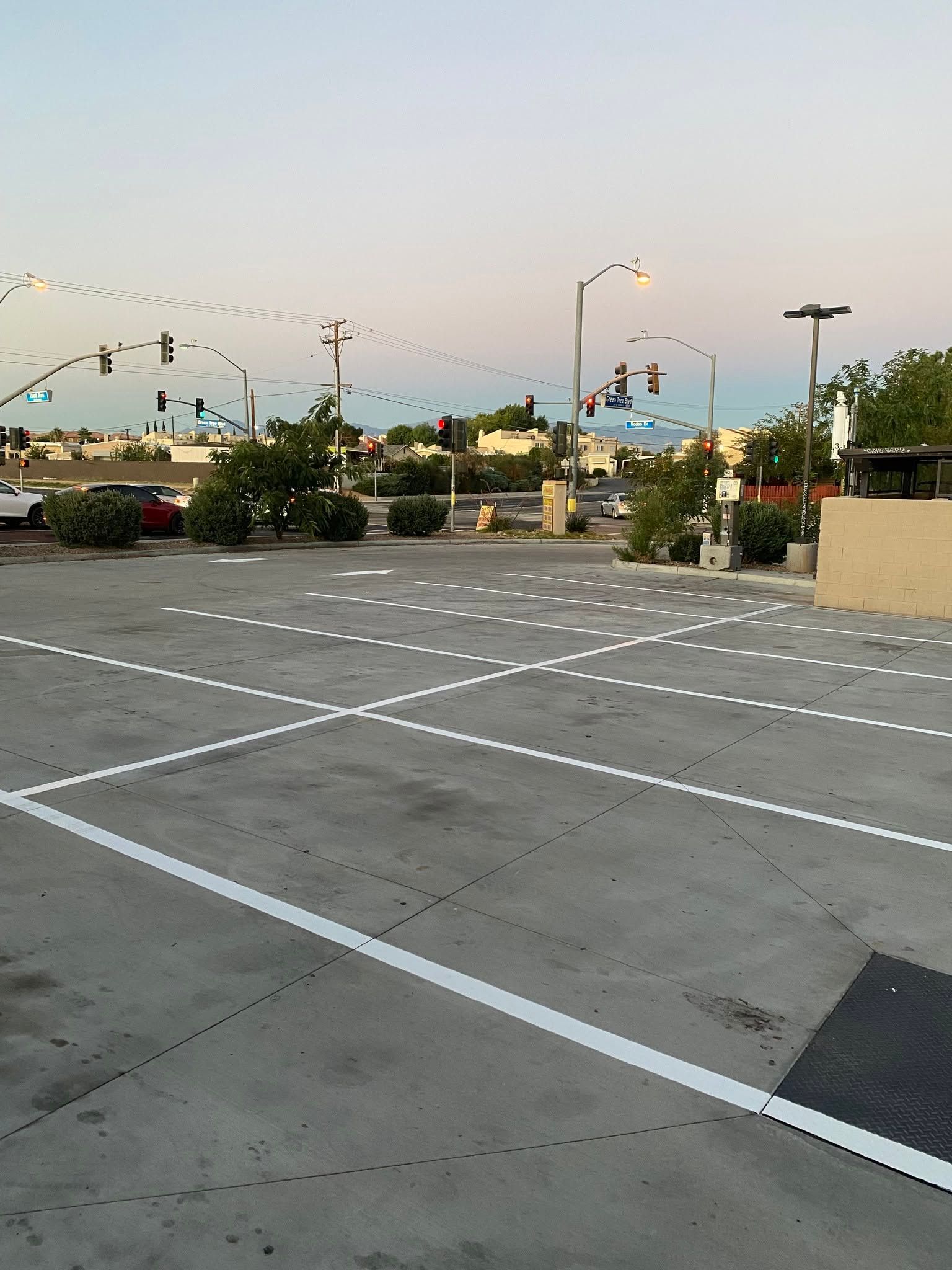
What You Notice Once Striping Work Is Finished
Traffic paint used for parking lot striping varies in formulation, and the choice affects how long markings stay visible under Southern California's UV conditions and tire wear. Water-based traffic paint is commonly used for standard stalls and directional markings, while thermoplastic or more durable formulations are sometimes appropriate for high-traffic areas that see frequent turning movements—those areas wear paint faster because tire friction is concentrated rather than straight-line. Proper application requires clean, dry pavement and the right machine speed to lay paint at consistent film thickness, which determines both initial brightness and how long the line stays legible before it needs refreshing.
After line striping is completed, stall boundaries are clearly visible from the driver's approach angle, directional arrows read at normal driving speed, and ADA spaces are fully marked with the required surface symbols, access aisle designations, and adjacent signage. 4 Lakes Landscape lays out the lot before beginning to confirm stall count and placement, so the finished result reflects the intended parking capacity rather than a rushed approximation that wastes usable space.
Restriping an existing lot is simpler than a new layout, but both require attention to what's already on the pavement—old lines that conflict with the new layout need to be blocked out rather than painted over, or they create visual confusion for drivers. New construction striping involves establishing the entire layout from scratch based on the site plan and applicable standards.
Questions Before Starting Your Project
These questions reflect what commercial property owners and managers typically need to understand before scheduling parking lot striping or remarking work in South El Monte.
How many ADA-accessible spaces does a parking lot require?
The required number of accessible spaces is calculated as a percentage of total lot capacity under ADA standards, and California's Title 24 may require van-accessible spaces at a higher ratio than federal minimums—a layout review confirms the specific requirement for your lot size.
What paint type lasts longest on asphalt parking lots in Southern California?
Water-based traffic paint is standard for most applications, but high-traffic turning areas and stop bars often benefit from thicker or more durable formulations because those areas wear paint faster under repeated tire contact.
When should old lines be blacked out rather than just repainted over?
When a layout change moves stalls or aisles significantly, the old lines need to be covered with black-out paint before new lines go down—overlapping visible lines create confusion that causes parking and traffic flow problems.
Why does striping need to be done after sealcoating rather than before?
Fresh sealer must be fully cured before paint is applied, because paint applied to uncured sealer peels rather than bonding—the standard practice is to sealcoat first, allow full cure, then stripe.
How does a parking lot layout review work before striping begins?
The lot dimensions are measured, the total stall count is calculated, drive aisle widths are verified against minimum standards, and the number and placement of ADA spaces are confirmed before layout is marked and paint is applied.
4 Lakes Landscape handles the layout planning and compliance review as part of the striping process, not as a separate step. Call (626) 202-3211 to discuss your commercial parking area and confirm what the project requires before scheduling begins.